Server-side tracking in Shoporama
Complete guide to server-side tracking in Shoporama. Better data quality, fewer ad-blocker losses and faster pages, without compromising GDPR.
Server-side tracking gives you significantly better data about your visitors and your conversions. Fewer losses from ad-blockers, faster pages and data that meets modern privacy requirements. In this article, you'll learn what server-side tracking is, how it works in Shoporama and how to set it up step by step.
Good to know before you get started
- Server-side tracking costs 89,- excl. VAT per month. The amount is deducted from your normal subscription.
- If you have server-side tracking under control, you can set up your own solution without our solution.
- If you use both your own and our solution, we do not provide support as the two easily conflict. Choose one solution.
- It is a requirement that you use Google Analytics 4 (GA4) to use Shoporama server-side tracking.
What is server-side tracking?
Classic tracking takes place in the customer's browser. Pixels and scripts from Google, Meta and others are loaded and data is sent directly from the browser to each platform. The problem is that ad-blockers, browser restrictions and strict cookie rules are increasingly blocking these signals. The result is unreliable numbers, poor ad optimization and lower ROAS.
With server-side tracking, we send data from Shoporama's servers to Google, Meta and others instead of from the browser. This results in more complete data, faster pages and better control over what is shared and when.
How Shoporama's solution works
We use a server-side Google Tag Manager, often abbreviated sGTM. The container is hosted at Stape.io, which specializes in this solution. We automatically create your container when you activate the service.
What happens if the user only accepts necessary cookies? If the user selects "only necessary", we only use cookies to manage the shopping cart. These are purely functional cookies that the webshop cannot function without.
We can still send cookie-less signals to Meta, GA4 and Google Ads when a purchase is completed. This is done via Google Ads Offline Conversions and server-side events to Meta.
An example: A customer completes a purchase. Shoporama now knows the customer's email. We can send it to Google and Meta along with a message that the user has completed a purchase worth X DKK. This is done without cookies, but you must of course describe this type of tracking in your privacy policy.
Step 1: Enable server-side tracking in Shoporama
Go to Tracking in admin and check "Enable tracking". Then check "Enable server-side tracking".
Once enabled, Shoporama will suggest a tracking domain. For example, if your webshop is called minwebshop.dk, we suggest a.minwebshop.dk. You can also choose your own subdomain.
Step 2: Create DNS records with your domain provider
Once you have set your tracking domain, Shoporama will show you the DNS records you need to create. There are two records in total:
- A record on your tracking subdomain (for example, a.minwebshop.dk) that points to Shoporama's tracking IP. The exact IP address is displayed on the page.
- CNAME record on load.<your subdomain> (for example, load.a.minwebshop.com) pointing to Staples loader domain. The value is displayed on the page.
Important: Do not create an AAAA (IPv6) record. Shoporama only uses A-record + CNAME. Creating an AAAA may result in unexpected behavior.
The exact values are directly on the tracking page in Shoporama and you can copy them with one click. The records are created at the provider that controls your DNS. If you are unsure where this is, you can look up your domain at punktum.dk.
When both records have been created and have made it online, your DNS status will change to "Ready". We check if they are correct once an hour, so it can take up to an hour from the records being correct until the status changes. If the status does not change within 24 hours, write to support@shoporama.dk and we will look into it.
Step 3: Choose what you want to track
On the tracking page you choose what you want to track. On the left side, it is important that you select "Server-side tracking" and Google GA4. These are the only ones that are required.
When you select a tracking channel, the corresponding fields pop up. For example, if you want to track Meta/Facebook, we ask for your Facebook Pixel ID and a Facebook Access Token (Conversion API).
In addition, you or whoever manages your Google Ads account should fill in:
- Google Ads Conversion ID
- Google Ads Conversion Label (Purchase)
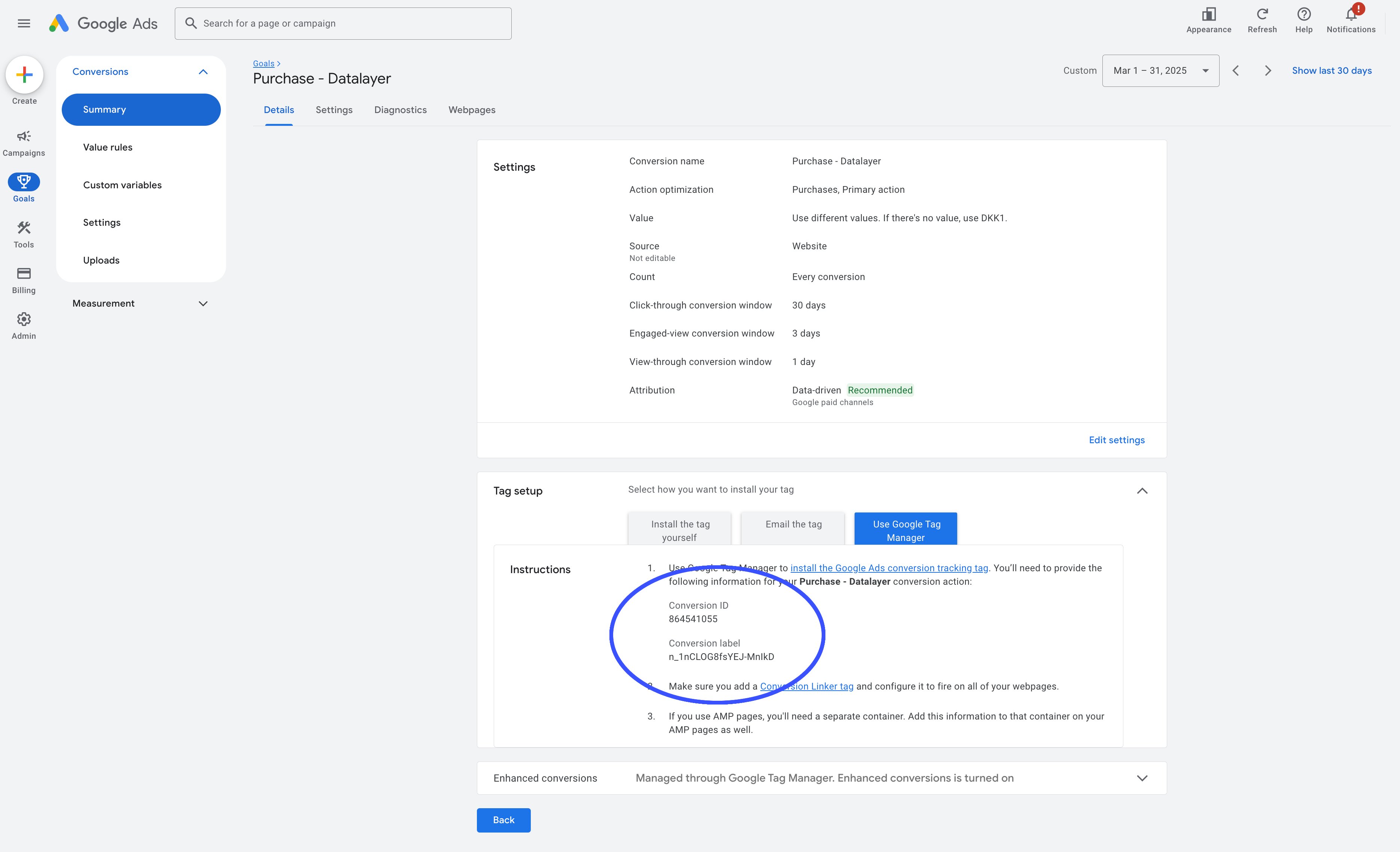
Here you will find your Conversion ID and Conversion Label:
If you want to use Google Ads Offline Conversions
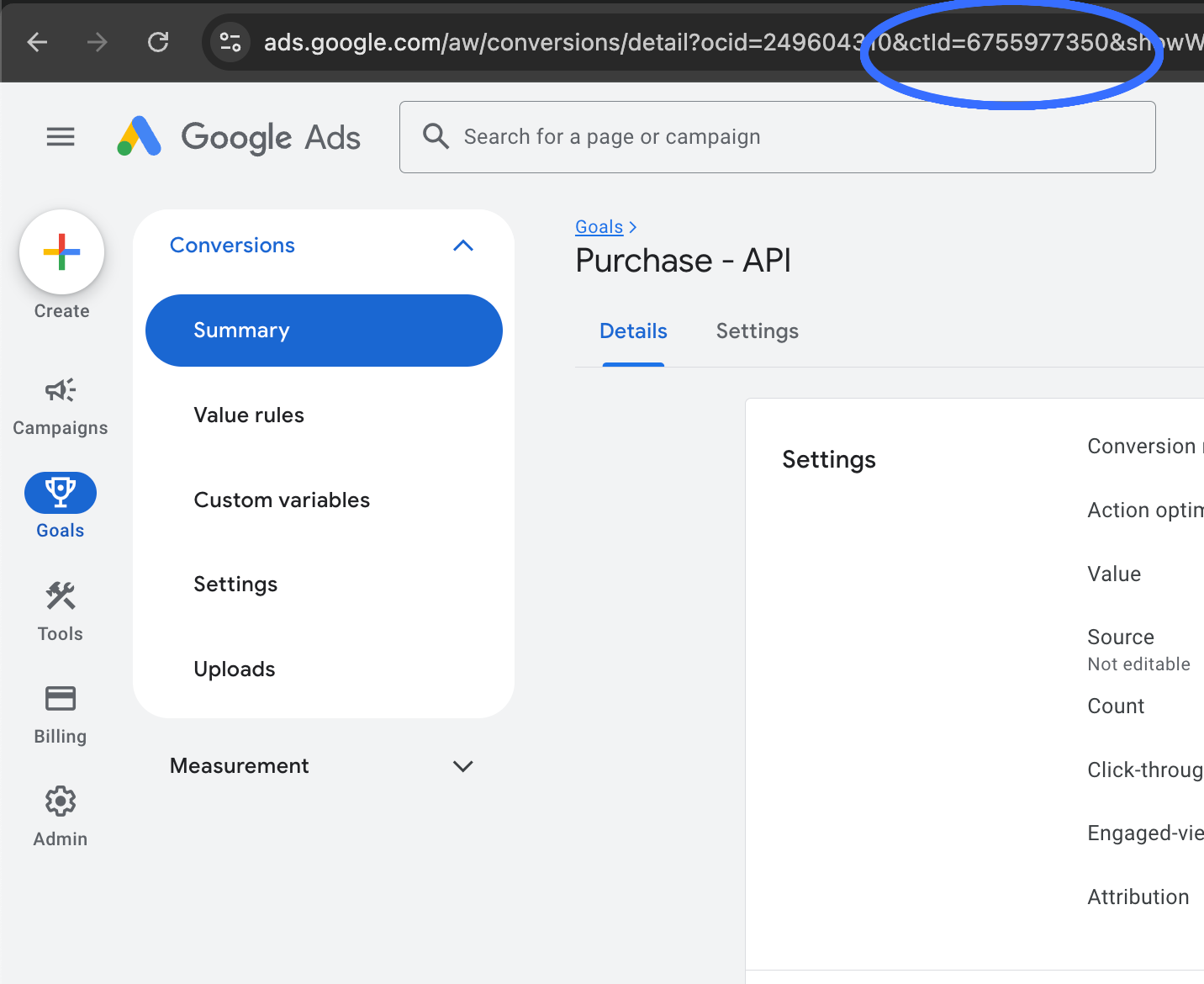
If you want to use Google Ads Offline Conversions, you need to fill in a few more fields. You can find your Conversion Action ID in the URL of the individual conversion in Google Ads:
What is the Google Ads Operating Customer ID?
If you don't know what it is, you probably don't need to fill it in. This field is only used if your account is managed by a Google Ads agency via a Manager Account (MCC).
If you want to use Google Ads Offline Conversions, you need to invite ads@shoporama.dk as an administrator on your Google Ads account. It's a bit more complicated to set up, but you get better data. Once you've invited us, let us know so we can accept the invitation.
Setting up in your Google Ads
You should create a source in Google Ads where you import your offline conversions. That way, you get one conversion that counts purchases from the website and one that counts purchases from the API. This gives the most accurate picture.
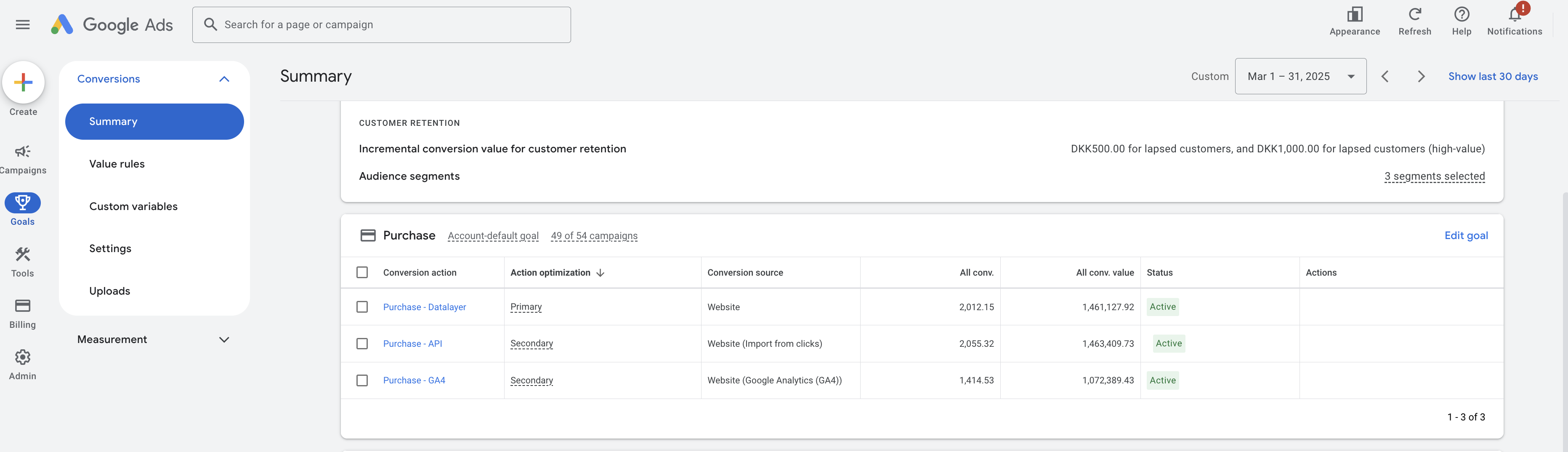
Create a Conversion Action of type "Import from clicks". This is what the setup looks like:
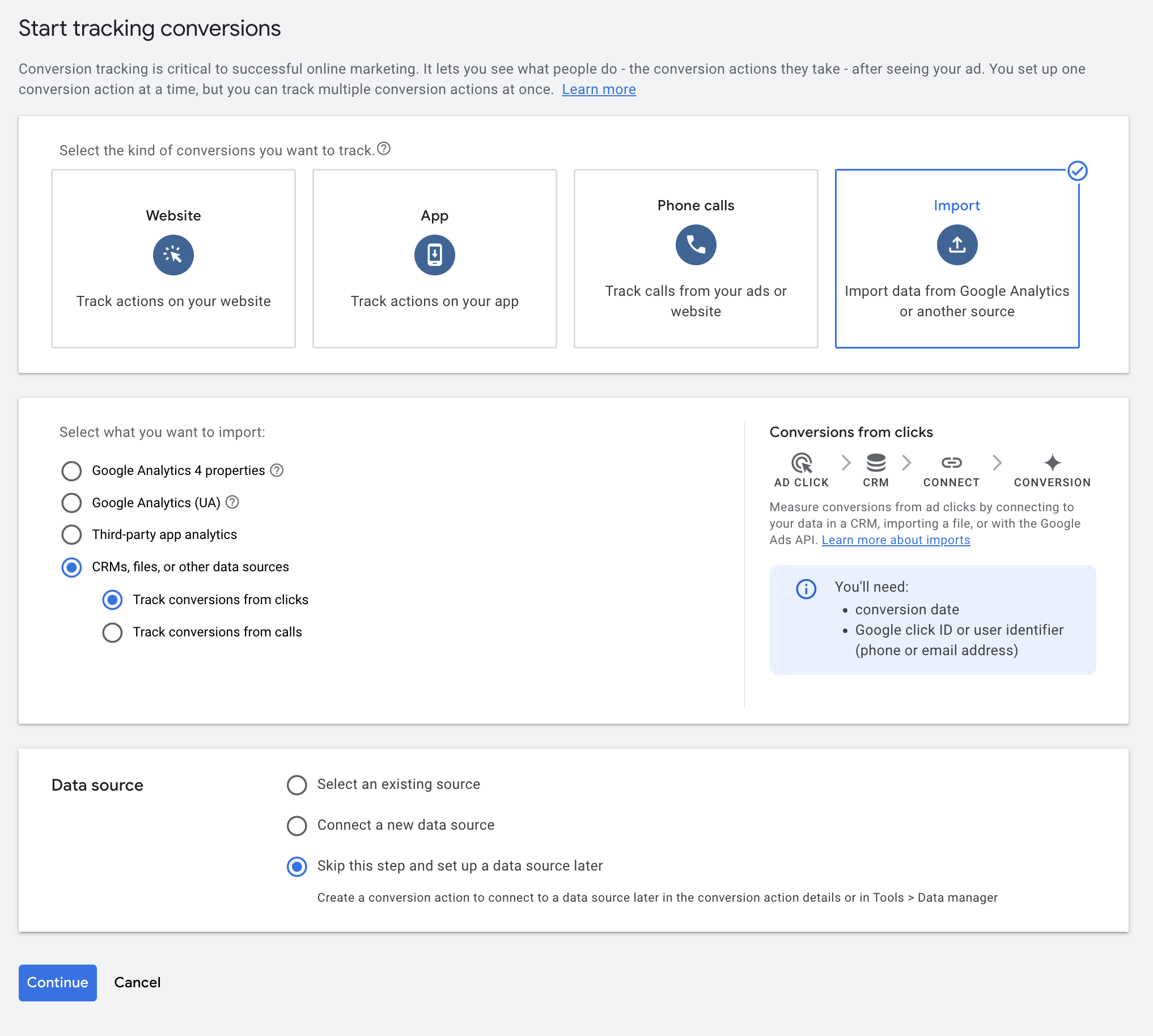
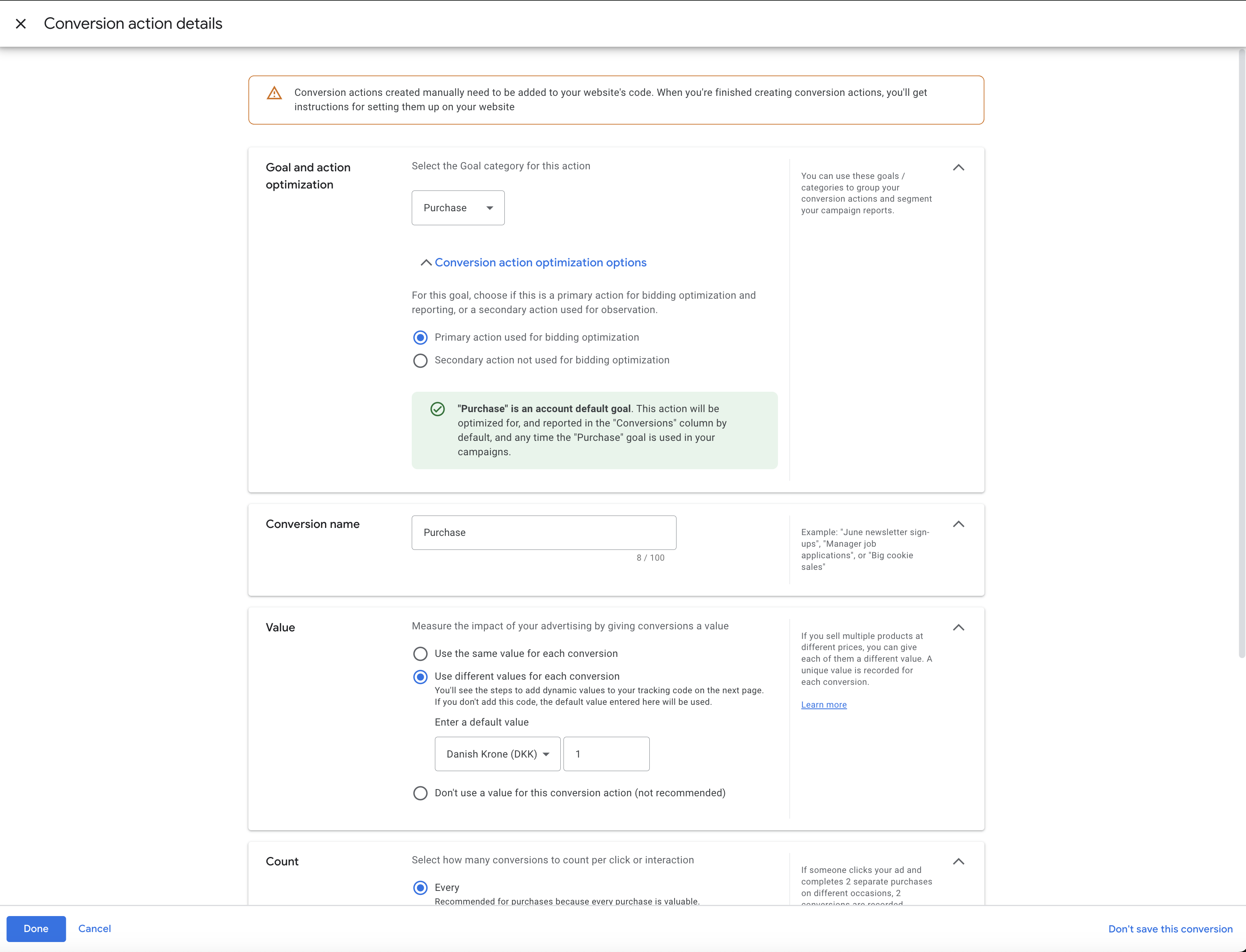
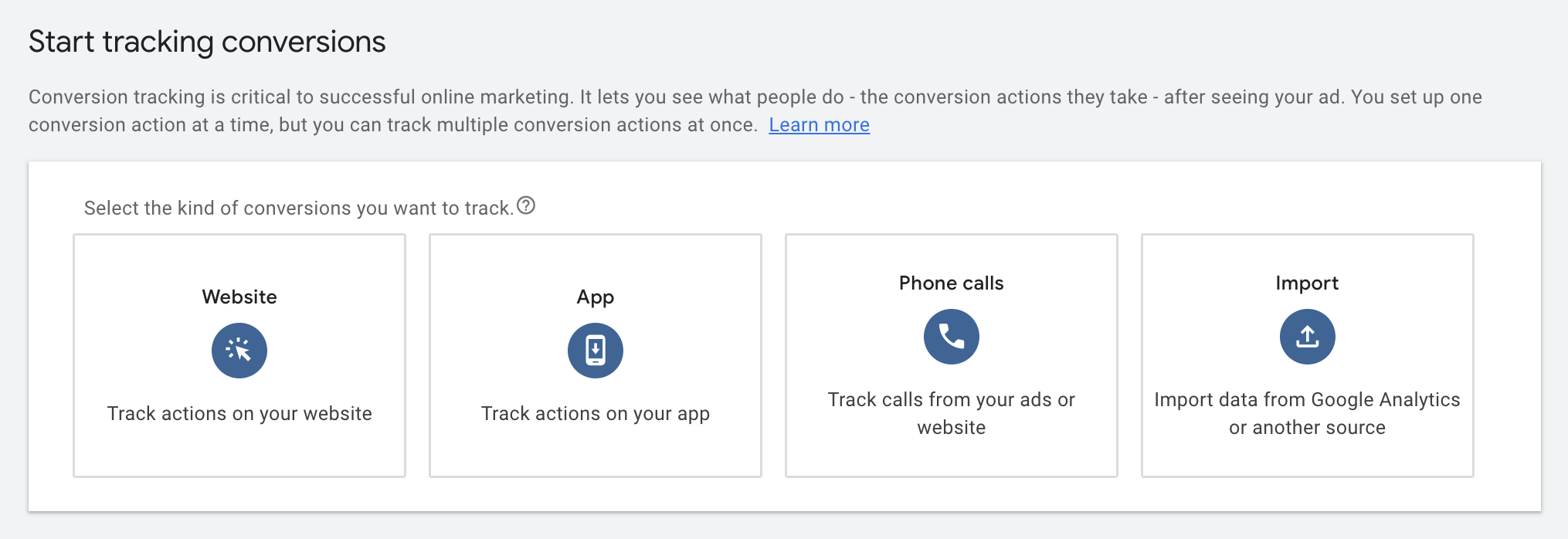
You need both a source that pulls from your website and one that pulls from imports:
Microsoft Ads offline conversions
In addition to Google Ads, Shoporama also supports offline conversions for Microsoft Ads. When a customer clicks on a Microsoft ad, we store the click ID (msclkid) on the order and send it back upon purchase.
Enable Microsoft Ads under Tracking to get a CSV URL with username and password. Set up automatic import in Microsoft Ads to match conversions with ad clicks. See the separate article Google and Microsoft Ads offline conversions for a complete guide.
Frequently asked questions
What does server-side tracking actually do for my online shop?
Server-side tracking sends conversion and behavioral data from Shoporama's servers instead of directly from the browser. This means you capture more purchases and events because data is no longer blocked by ad-blockers or browser restrictions. In practice, you typically see 10-30% more recorded conversions in Meta and Google Ads compared to classic pixel tracking.
Do I need to create a AAAA record?
No, you don't. Shoporama only uses an A record on your tracking subdomain and a CNAME record on load.<your subdomain>. You don't need to create an AAAA record (IPv6) for server-side tracking to work, and at worst, it can cause problems if you do.
Does server-side tracking bypass ad-blockers?
For the most part, yes. Because data is sent via your own tracking subdomain (e.g. a.minwebshop.dk) instead of from well-known third-party domains like facebook.com or google-analytics.com, the signals are not picked up by most ad blockers. This provides significantly more complete data, especially on purchase and add_to_cart events.
Does server-side tracking affect my page speed?
Quite the opposite. When data is sent server-side instead of via client-based pixels and scripts, you reduce the number of third-party scripts that need to be loaded in the browser. This results in faster pages, better Lighthouse scores and better numbers in Core Web Vitals, which also affects SEO.
Is server-side tracking GDPR-friendly?
Server-side tracking is not automatically GDPR-friendly, but it gives you better tools for compliance. You have full control over what data is passed on. We respect the user's consent (consent mode) and only when the customer has accepted marketing cookies do we send personally identifiable data. Always remember to describe your tracking in your privacy policy.
Do I need to use Consent Mode?
Yes, if you want to comply with European legislation. If you use a recognized solution like Cookieinformation, Cookiebot (V2) or Openli (formerly Legalmonster), consent mode is automatically taken care of. If you use a proprietary or less well-known solution, you need to ensure that consent signals are correctly sent to Google.
What exactly is Consent Mode?
Consent Mode means that we respect the user's choice from the cookie banner. If the user has not consented to marketing, cookies are restricted and only anonymized signals are sent. If you use a solution we don't support directly, you can send consent updates manually with the following code:
<script> window.dataLayer = window.dataLayer || []; window.dataLayer.push({ event: 'cookie_consent_update', consent: { ad_storage: 'granted', analytics_storage: 'granted', functionality_storage: 'granted', personalization_storage: 'granted', security_storage: 'granted', ad_user_data: 'granted', ad_personalization: 'granted' } }); </script>How long does it take for the DNS status to change to Ready?
DNS changes typically take effect within a few hours, but in rare cases can take up to 24-48 hours depending on your provider. Shoporama checks the records once an hour, so it can take up to an extra hour for the records to be correct before the status changes to "Ready".
Is it a requirement that I use GA4?
Yes, it is. GA4 is the backbone of our server-side tracking and you cannot use the solution without it. If you don't have a GA4 account yet, read our guide to Google Analytics 4 on Shoporama.
Can I scale it across multiple eCommerce stores?
Yes, you can. Each shop gets its own sGTM container and tracking subdomain. It's a repeatable setup: Activate, create two DNS records, insert tracking IDs. In 10-15 minutes per shop, you're ready to go.
If you have any questions or need help, feel free to contact us at support@shoporama.dk.
Related articles
Google Analytics 4 (GA4) on your Shoporama online store
How to set up Google Analytics 4 on your Shoporama online store. Built-in GA4 integration with e-commerce events, server-side tracking and Consent...
Offline conversions for Google Ads and Microsoft Ads
Send your Shoporama orders as offline conversions to Google Ads and Microsoft Ads. Get full attribution of sales to clicks via a secure CSV feed.
Implement tracking in a Shoporama theme
Developer guide to implement e-commerce tracking in a Shoporama theme with standard data layer, Google Tag Manager and custom events.
What cookies does Shoporama set?
Overview of all cookies that Shoporama sets in webshops - useful for privacy policy and cookie consent.
Implement Pricerunner tracking
Guide to implementing Pricerunner conversion tracking on your Shoporama online shop with proper Smarty code.
Related features
Server-side tracking - accurate tracking without cookies
Server-side tracking for Google, Facebook, Pinterest, TikTok, LinkedIn and Microsoft Ads. Unaffected by adblockers. Included in Shoporama Pro.
Shoporama vs DanDomain
Compare Shoporama and DanDomain on price, speed, AI features and integrations. See which Danish webshop platform is best for your business.
Shoporama vs WooCommerce
Compare Shoporama and WooCommerce: price, security, speed, GDPR and maintenance. Find the best online shopping platform for your business.