How the E-conomic integration works
How the e-conomic app transfers your orders from Shoporama to e-conomic. Explanation of synchronization, delay, VAT, debtors, discounts and error handling.
Shoporama’s e-conomic app automatically transfers your orders from the online store to e-conomic, so you don’t have to enter them manually. Exactly how the integration works depends on your settings. Here, we’ll walk you through the entire process so you know what to expect in your accounting and how long it takes.
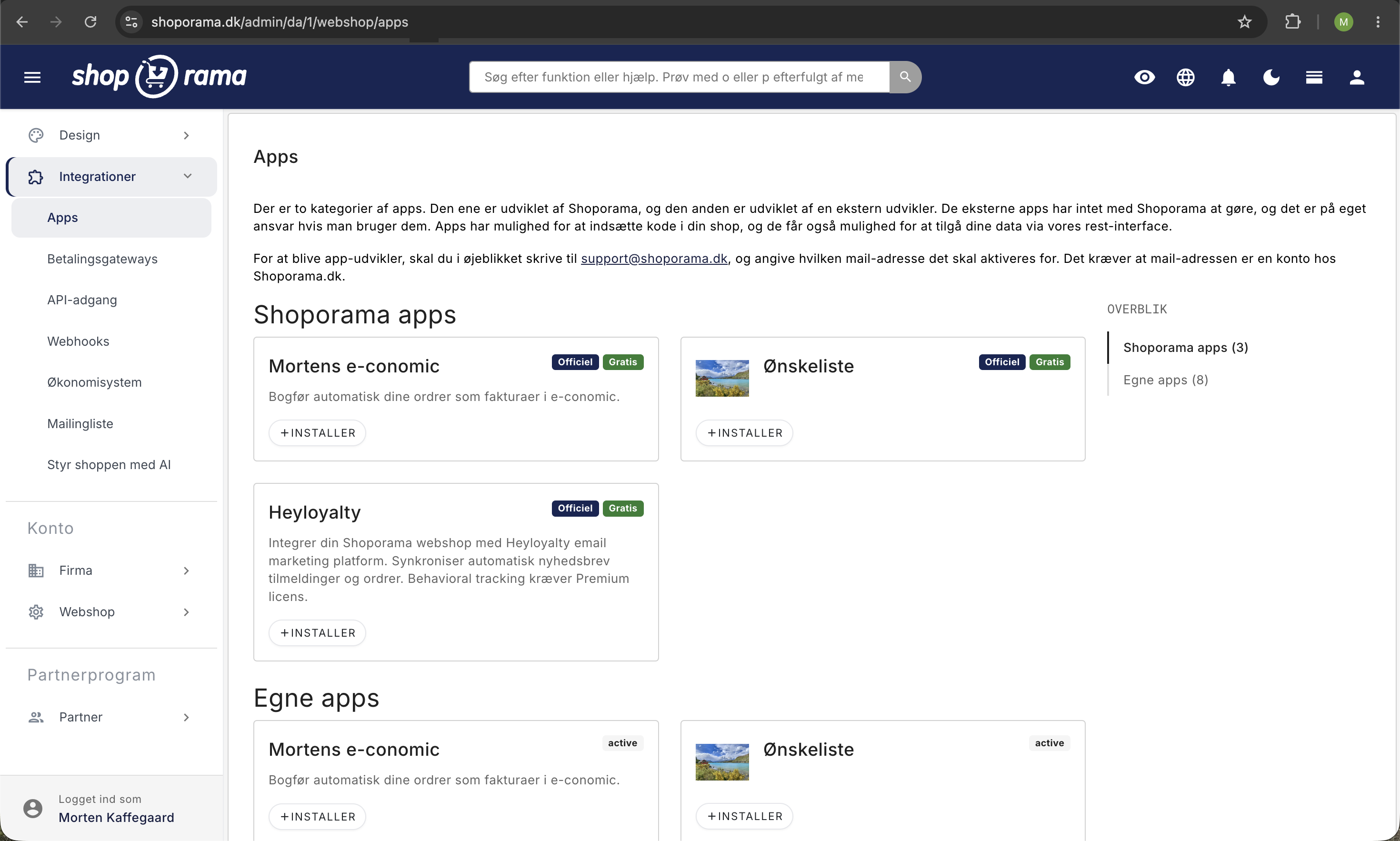
When is an order marked for transfer?
In the app settings, you choose when an order should be marked for synchronization with e-conomic. You can choose between three time points:
- Upon creation, as soon as the customer completes the order in the online store.
- Upon payment, once the payment gateway has approved the payment.
- Upon shipment, when you mark the order as shipped in Shoporama.
When the trigger is met, a notification about the order is placed in Shoporama’s internal event queue. It is this notification that initiates the actual transfer to e-conomic.
How the synchronization works
The transfer is queue-based, not a real-time webhook. The flow is as follows:
- When the trigger is met (created, paid, or shipped), an event is added to the store’s event queue.
- A background job on the Shoporama server continuously processes the queue and forwards the current orders to the e-conomic app.
- The app retrieves the order via Shoporama’s REST API, maps the customer, tax zone, line items, and discounts, and sends the data to e-conomic as either a draft order or a draft invoice.
- If you have enabled automatic posting, the invoice is posted immediately in e-conomic. Otherwise, it remains as a draft until you post it yourself.
In practice, it typically takes less than a minute from the time the trigger is activated until the order appears in e-conomic. If e-conomic is down or responding slowly, it may take longer, but the order won’t disappear. You can also manually send an order by adding the label “e-conomic-pending” to the order.
Tip: Each order is assigned a label that indicates its status: e-conomic-pending, e-conomic-ok, or e-conomic-failed. Filter the order list by “e-conomic-failed” to quickly find orders that could not be transferred.
What data is sent to e-conomic?
For each order that is transferred, Shoporama sends the following to e-conomic:
- Customer: name, address, ZIP code, city, country, email, phone number, and CVR/EAN. If the customer does not exist as a customer in e-conomic, a record is created automatically.
- Invoice recipient and shipping address, so the packing slip is correct.
- Item lines with SKU, name, quantity, unit price, and VAT rate.
- Shipping as a separate line.
- Deposits and security deposits as separate item lines with their own item numbers (the item is automatically created in e-conomic if it does not exist). Read more in the article on deposits and security deposits.
- Discounts as negative lines (gift cards/discount codes, promotional discounts, and redeemed loyalty points).
- Reference: Shoporama’s order number (and, if applicable, cart ID) is saved as a reference on the invoice so you can easily find the order again.
- Layout and payment terms based on your settings (card vs. EAN/invoice).
Which customer account is the sale posted to?
In the app configuration, you choose how the customer number is determined:
- Fixed customer: All sales are posted to the same customer number (e.g., a combined “Webshop Customers” account).
- Phone number: The customer number is generated based on the customer’s phone number.
- Customer number: The customer’s unique ID from Shoporama is used (requires the customer to be logged in).
- Unique number: Each new customer is assigned their own sequential customer number in e-conomic.
If a customer does not already exist, it is automatically created with an address, city, ZIP code, email, phone number, CVR/EAN, and contact person. You can also choose separate customer groups for private customers (B2C) and business customers (B2B with CVR/EAN), making your accounting easier to understand.
How is VAT handled?
Shoporama automatically sets the correct VAT zone on the invoice in e-conomic. This means you don’t have to manually distinguish between sales to private customers and sales to businesses, or between domestic sales and exports. The VAT zone is determined based on:
- The customer’s country of delivery.
- Whether the customer is a private individual (B2C) or a business with a CVR or EAN number (B2B).
- Your own country of residence, which you set in the app settings.
In practice, it works like this:
- Domestic sales—sales to customers in your own country—are recorded in the domestic VAT zone, typically with 25% Danish VAT.
- EU sales to businesses—sales to companies in other EU countries (with a CVR number)—are recorded according to the reverse charge rules, under which you, as the seller, do not collect VAT.
- EU sales to private individuals—sales to private customers in other EU countries—are handled according to the OSS rules. Each EU country has its own VAT zone in e-conomic.
- Norway (VOEC): Special handling can be enabled for VOEC schemes involving Norwegian customers.
- Exports—sales to countries outside the EU—are recorded as exports without VAT.
For this to work, the corresponding VAT zones must be set up in your e-conomic agreement. Read more about B2B handling in the article “B2B Sales in Shoporama.”
How are discounts transferred?
Discounts are transferred as separate lines on the invoice in e-conomic, so you can see exactly what type of discount the customer received and how much it is. Shoporama divides discounts into three categories:
- Gift cards and discount codes appear as the “Discount” line item on the invoice.
- Promotional discounts, volume discounts, automatic promotions, and category discounts appear as the "Promotional Discount" line item.
- Loyalty points: If the customer redeemed points in connection with the purchase, they appear as the "Points used" line with the number of points used.
The discount lines have a negative amount and are automatically deducted from the order total in e-conomic. The net amount is calculated based on the order’s actual VAT rate, ensuring accuracy for Danish sales with 25% VAT, VAT-exempt B2B sales to the EU, and exports to third countries.
Product Management
The new e-conomic app does not transfer products as master data to e-conomic. Instead, the product is created as a line item on the invoice with the stock keeping unit (SKU), name, and price. You therefore do not need to maintain a product catalog in e-conomic.
If a product already exists in e-conomic with the same SKU, e-conomic automatically uses it. Otherwise, a simple line item is created on the invoice.
Draft invoice or posted immediately?
You can choose whether the invoice should be posted automatically in e-conomic or remain as a draft until you review and post it yourself. If you want extra control over your accounting, we recommend leaving invoices as drafts so you can correct typing errors, change account assignments, or make adjustments before they become final.
What isn’t synced?
The e-conomic app is one-way: data flows from Shoporama to e-conomic, not the other way around. Specifically, this means:
- Inventory is managed exclusively in Shoporama. Changes made in e-conomic do not affect the online store’s inventory.
- Products—such as master data and product information—are not transferred as a master file to e-conomic, only as line items on invoices.
- If youmake corrections to a posted invoice—for example, by editing an order in Shoporama after it has been transferred—the corresponding document in e-conomic will not be updated. If the invoice has been posted, you must issue a credit memo in e-conomic.
- Payment status: If you mark an invoice as paid in e-conomic, the order is not updated in Shoporama.
Frequently Asked Questions
How long does it take before I can see the order in e-conomic?
Usually less than a minute. When the trigger is activated (created, paid, or shipped), the order is placed in the event queue, and the background job forwards it to e-conomic shortly thereafter. If e-conomic is temporarily unavailable, it may take longer, but the order will not disappear.
What happens if e-conomic is down or an order fails?
The order is labeled “e-conomic-failed,” and the error message is included in the order’s notes. You can restart the transfer yourself by removing “e-conomic-failed” and adding “e-conomic-pending.” It will start over as soon as the queue is processed.
Can I see which orders have been transferred correctly?
Yes. Each order is assigned one of the following labels: e-conomic-ok (transferred), e-conomic-pending (in queue), or e-conomic-failed (failed). Filter the order list by label, or view the status directly on each individual order.
Anne (bookkeeper): Does the VAT in e-conomic match my Shoporama statistics 100%?
As a general rule, yes. Minor discrepancies at the øre level may occur due to rounding between the systems. If the figures differ significantly, check the VAT zones, the currency, and whether all orders have actually been transferred (filter the order list by “e-conomic-pending” and “e-conomic-failed”).
Anne (bookkeeper): What do I do when a customer requests a credit memo?
Create the credit memo in Shoporama, either from the returns center or by using “Save and Create Return Items” at the bottom of the order. The app will then handle the rest: the credit memo is automatically sent to e-conomic as a separate document with negative line items. You don’t need to enter anything into e-conomic. Make sure the “e-conomic-ok” label appears on the credit memo itself, not on the original order. You’ll refund the actual amount afterward—for most payment gateways, directly from the credit memo in Shoporama. Read more in “Credit Memos and Refunds.”
Jonas (e-retailer): Can I sync multiple shops to the same e-conomic agreement?
Yes. Each Shoporama store is set up separately within the e-conomic agreement via the app. It’s a good idea to use fixed, separate customer numbers or customer groups for each shop so you can easily report on them individually. Choose layout numbers so it’s clear which shop the invoice comes from.
Jonas (e-retailer): What happens if I receive 500 orders on a promotional day?
The queue handles it automatically. Orders are placed in the queue one by one, and the background process handles them continuously. Even during peak periods, the delay is typically measured in minutes, not hours. Check the “e-conomic pending” label to see if there’s a backlog.
Gitte (store owner): Do I need to maintain my product catalog in two places?
No. Products are stored only in Shoporama. On the invoice in e-conomic, the item line includes the SKU, name, and price. If you already have a product record in e-conomic with the same SKU, e-conomic will reuse it. Otherwise, it’s simply entered as a standard item line.
Gitte (store owner): What do I do if I end up modifying an order in Shoporama?
If the order has already been transferred to e-conomic, the invoice won’t be updated automatically. You must either correct the invoice directly in e-conomic or cancel it there and transfer the order again by removing the “e-conomic-ok” status and adding “e-conomic-pending.” Note: If the invoice has already been posted, it cannot be changed—only credited.
Where can I find the error message if an order fails?
Open the order in Shoporama and check the notes and error field. Common causes include an invalid API key, missing customer information, or a VAT zone that isn’t included in your e-conomic agreement. Read more in Troubleshooting the e-conomic Integration.
Read more
- Set up the e-conomic integration
- Troubleshooting the e-conomic integration
- Common Errors in the e-conomic Integration
- B2B sales in Shoporama
- Credit notes and refunds
Need help? Contact us at support@shoporama.dk.
Related articles
Troubleshooting E-conomic integration
Guide to troubleshooting the e-conomic app in Shoporama. Fix sync issues, failed transfers and incorrect posting.
Set up E-conomic integration
Step-by-step guide to install Shoporama's e-conomic app from the App Store and set up automatic transfer of orders.
Typical errors in the E-conomic integration
Overview of common errors in the e-conomic app and how to fix them.
B2B sales in Shoporama
How to sell to businesses (B2B) and public institutions (B2G) in Shoporama with CVR, EAN and differentiated VAT.
Credit notes and refunds
Complete guide to credit notes and refunds in Shoporama, including partial refunds, full credit notes and transfer to accounting systems.