Customer retention - target repurchase and cohort analysis
Understand your customer retention with Shoporama's cohort analysis. See reorder rates, time to repurchase and a visual heatmap showing how well you retain customers over time.
Hvad viser kundefastholdelse-statistikken?
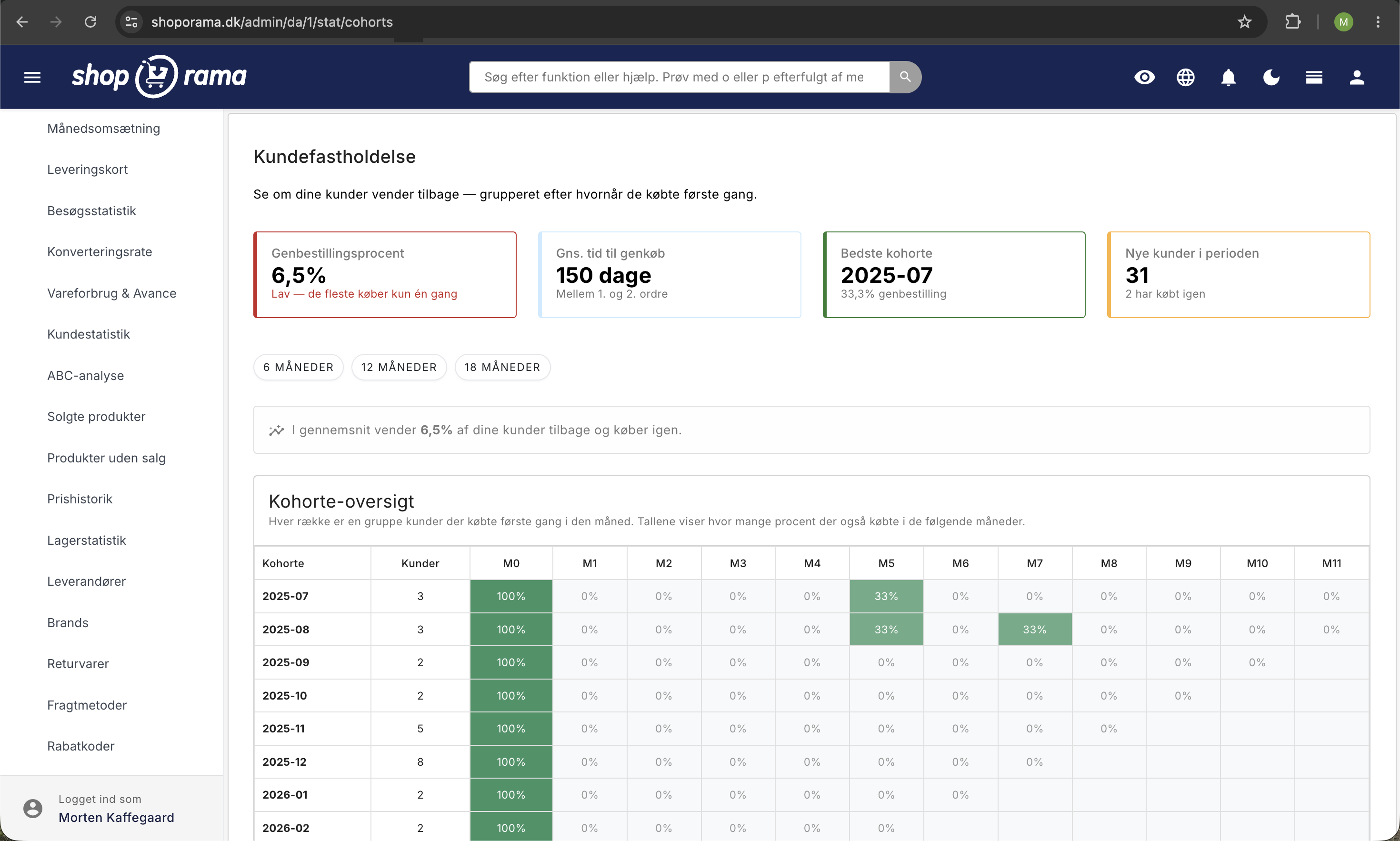
Under Statistik → Kundefastholdelse kan du se, hvor godt du er til at fastholde dine kunder over tid. Siden bruger kohorte-analyse til at vise, om dine kunder vender tilbage og handler igen — og hvornår de gør det.
Det er langt billigere at fastholde en eksisterende kunde end at skaffe en ny. Derfor er kundefastholdelse et af de vigtigste nøgletal for en webshop med ambitioner om langsigtet vækst.
De fire nøgletal øverst
- Genbestillingsprocent — andelen af kunder der har handlet mere end én gang. En genbestillingsprocent på 20-30% er typisk for mange webshops, men det varierer meget efter branche.
- Gennemsnitlig tid til genkøb — hvor lang tid der typisk går, fra en kunde handler første gang til de vender tilbage. Denne indsigt er guld værd til at time opfølgningsmails.
- Bedste kohorte — den måned-gruppe af nye kunder der har den højeste fastholdelsesrate. Det kan afsløre hvilke kampagner eller sæsoner der tiltrækker de mest loyale kunder.
- Nye kunder — antal førstegangskunder i den valgte periode, så du kan se om du tiltrækker nye kunder i et sundt tempo.
Hvad er en kohorte?
En kohorte er en gruppe kunder der deler et fælles træk — i dette tilfælde den måned, de handlede første gang i din webshop. Fx er "januar 2026"-kohorten alle kunder der lagde deres allerførste ordre i januar 2026. Ved at gruppere kunderne sådan, kan du sammenligne hvordan forskellige grupper opfører sig over tid.
Sådan læser du heatmappet
Heatmappet er et gitter med farvekodede celler:
- Rækkerne repræsenterer kohorter — grupper af kunder baseret på hvornår de handlede første gang (fx "Jan 2026", "Feb 2026")
- Kolonnerne repræsenterer måneder efter første køb — M0 er måneden de handlede første gang, M1 er måneden efter, M2 er to måneder efter osv.
- Celleværdien viser procentdelen af kohorten der handlede igen i den pågældende måned
- Farverne går fra lys (lav fastholdelse) til mørk (høj fastholdelse)
M0-kolonnen viser altid 100%, fordi alle kunder per definition handlede i deres første måned. Kig på M1, M2, M3 osv. for at se, hvor mange der vender tilbage. En typisk webshop ser et stort fald fra M0 til M1, og derefter en mere gradvis udflading.
Eksempel
Forestil dig at januar-kohorten har 200 nye kunder. Hvis M1 viser 12%, betyder det at 24 af de 200 kunder handlede igen i februar. Hvis M2 viser 8%, handlede 16 af de oprindelige 200 kunder i marts. Ved at sammenligne kohorter kan du se om nyere kunder er mere eller mindre loyale end ældre.
Tips til at forbedre kundefastholdelsen
- Brug gennemsnitlig tid til genkøb til at time opfølgning — hvis kunder typisk vender tilbage efter 45 dage, send en opfølgningsmail via nyhedsbrevsmodulet omkring dag 40 med relevante produktforslag eller et tilbud.
- Sammenlign kohorter — hvis én kohorte performer markant bedre end andre, undersøg hvad der var anderledes den måned. Var der en bestemt kampagne, et nyt produkt eller en sæsoneffekt?
- Aktivér loyalitetsprogram — et pointsystem giver kunder et incitament til at vende tilbage. Det kan have en mærkbar effekt på din genbestillingsprocent.
- Segmentér dine kunder — brug kundestatistikken til at forstå hvem dine bedste kunder er, og målret din kommunikation.
- Fokusér på kundeoplevelsen — hurtig levering, god kundeservice og en nem returproces er afgørende for om kunder vender tilbage. Det handler ikke kun om pris og produkter.
Kundefastholdelse er en langsigtet investering. Brug kohorte-analysen til løbende at evaluere om dine tiltag virker, og justér din strategi baseret på data — ikke mavefornemmelser.